Pakistan Says Diplomatic Engagement With Afghanistan Ongoing Despite Terrorism Concerns
NAEEM MEHBOOB:
Pakistan’s Ministry of Foreign Affairs said on Thursday that diplomatic channels with Afghanistan remain open and active, despite rising tensions between the two neighboring countries over cross-border terrorism.
Relations between Islamabad and Kabul have deteriorated in recent months, with Pakistan repeatedly accusing militant groups of operating from Afghan territory. Islamabad has urged Afghan authorities to take verifiable steps to dismantle these groups and prevent their soil from being used for attacks against Pakistan.
In October 2025, Pakistan shut down several major border crossings following one of the deadliest military escalations between the two countries in recent years. Although a ceasefire was announced on October 19, cross-border trade has yet to resume.
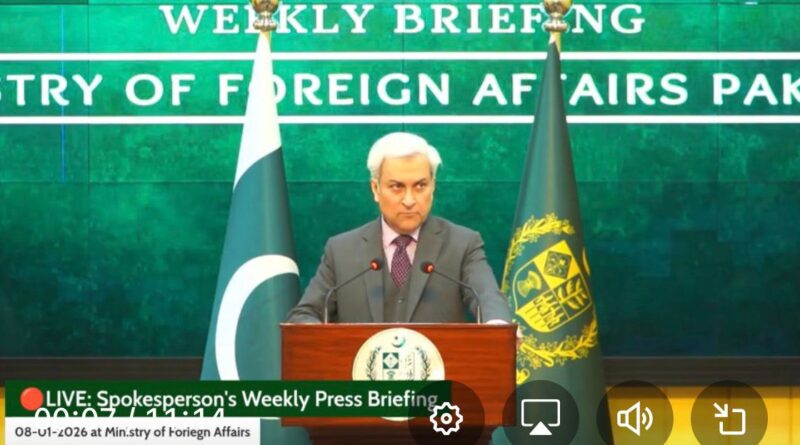
Speaking at a weekly press briefing, Foreign Office spokesperson Tahir Hussain Andrabi stressed that Pakistan does not interfere in Afghanistan’s internal affairs. However, he underscored that terrorism originating from across the border remains Islamabad’s top concern.
“Incidents of terrorism emanating from Afghanistan are a primary concern for Pakistan. Our demand is that Afghan territory should not be used against Pakistan,” Andrabi said.
He added that Pakistan requires “written, verifiable, and concrete assurances” from Afghan authorities to address the issue. “Without these written commitments, the issue of terrorism cannot be resolved,” he said, noting that eliminating terrorism would significantly improve bilateral relations.
“Pakistan and Afghanistan do not have any other major bilateral disputes,” the spokesperson added. He also said Afghanistan has the potential to become a regional hub if stability and security are ensured. “Ending terrorism is also in Afghanistan’s own interest,” he said.
Commenting on protests in Iran, Andrabi said Pakistan does not comment on Iran’s internal situation and strongly opposes interference in the internal affairs of any country.
Meanwhile, Inter-Services Public Relations (ISPR) Director-General Lieutenant General Ahmed Sharif Chaudhry said earlier this week that Afghan Taliban forces had attacked Pakistani border posts, prompting a strong military response.
“Whatever was needed was done, and a hard message was given,” he said, adding that Afghanistan has become a center of terrorist operations in the region.
Lt Gen Chaudhry claimed that links between Fitna al-Khawarij, the Tehreek-e-Taliban Pakistan (TTP), and India were fully exposed in 2025, posing a serious threat to regional peace and security. He alleged that the Afghan Taliban regime has found a “new hero” in Indian Prime Minister Narendra Modi.
“If Afghanistan and India wish to confront Pakistan, they are welcome to do so,” he said, adding that Pakistan is fully prepared.
Reaffirming Pakistan’s resolve to defeat terrorism, the ISPR chief said the fight against militancy would continue “at all costs.” He noted that Pakistan had closed its borders in recent months and targeted terrorist positions along the Afghan border in October 2025.
“We targeted the TTP, not the Afghan Taliban,” he said, claiming that dozens of militant-linked posts were destroyed within hours.
Referring to the 2020 Doha Agreement between the United States and the Taliban, Lt Gen Chaudhry said the Afghan Taliban had pledged that Afghan soil would not be used for terrorism. However, he said Afghanistan remains a stronghold for Fitna al-Khawarij and Fitna al-Hindustan, undermining regional security.