Uganda Opposition Prays as Museveni Poised to Extend Four-Decade Rule
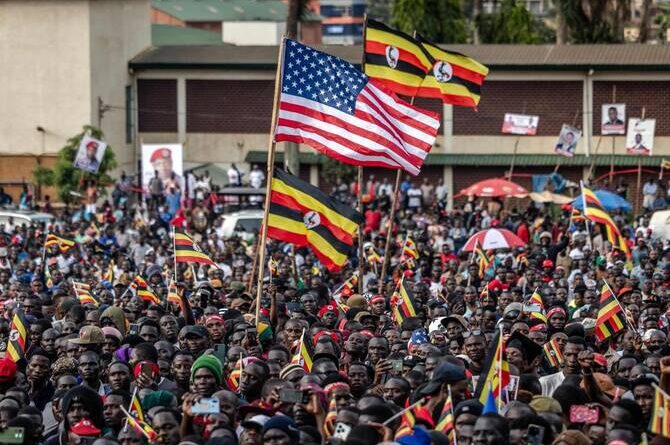
As dark clouds gathered overhead, supporters of Uganda’s long-embattled opposition—young and old—came together for prayers at the home of an imprisoned opposition leader, reflecting a mood that was both defiant and somber.
Addressing the gathering on Sunday, Kampala Mayor Erias Lukwago described this week’s election as a direct confrontation between ordinary Ugandans and President Yoweri Museveni.
“You are all in two categories: political prisoners and potential political prisoners,” Lukwago told attendees.
President Museveni is widely expected to secure another term in Thursday’s election, extending his nearly 40-year rule over the East African nation. Analysts attribute his expected victory to near-total control of state institutions and the security apparatus.
The 81-year-old leader rose to power as a bush fighter in the 1980s and has since maintained a heavily militarized grip on the country, repeatedly cracking down on political challengers.
The current election campaign has been marked by widespread repression. Hundreds of opposition supporters have been arrested and at least one person has been killed, with police claiming they are dealing with “hooligans.”
Main opposition candidate Bobi Wine, whose real name is Robert Kyagulanyi, is seldom seen in public without a flak jacket and has described the campaign as a “war.” He has been arrested numerous times in the past and says he was tortured while in military custody.
The only other prominent opposition figure, Kizza Besigye, was abducted in Kenya in 2024 and secretly transferred to a Ugandan military prison, where he now faces treason charges in a case that has dragged on for months.
Sunday’s prayer gathering was hosted by Besigye’s wife, Winnie Byanyima, the executive director of UNAIDS. She said Uganda’s democracy is largely superficial.
“We are really a military state,” Byanyima told AFP. “There is total capture of state institutions by the individual who holds military power, President Museveni.”
Police ‘Not Neutral’
Jude Kagoro, a researcher at the University of Bremen who has studied African policing for more than a decade, said Uganda’s police force does not view itself as politically neutral.
“The police officers I have met have never looked at themselves as neutral,” Kagoro said, adding that many officers see it as their duty to protect the incumbent leadership and often use force against opposition rallies without needing explicit orders.
According to Kagoro, the Museveni government has long relied on tactics to infiltrate and fragment opposition movements, including distributing handouts along ethnic lines.
Under an informal system known as “ghetto structures,” security agencies recruit young people from opposition strongholds to disrupt opposition activities and gather intelligence for the police, he said.
The government was caught off guard when Bobi Wine emerged as a powerful political force ahead of the 2021 election, galvanizing urban youth support. The state responded with what critics describe as extreme violence.
Kagoro noted that authorities have since worked to ensure they are not surprised again.
“For the last four-plus years, they have been building an infrastructure that can withstand any sort of pressure from the opposition,” he said.
“We are used to the military and the police on the streets during elections.”