
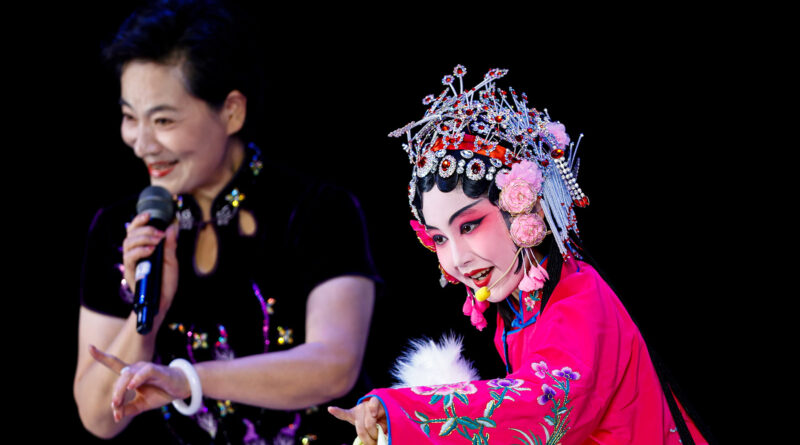
Tianjin’s Red Flag Theater Preserves Pingju Opera for the Seventh Generation
At the Red Flag Theater in Tianjin, the unique art of Pingju Opera is being passed down to its seventh generation of performers. Director Zeng Zhaojuan described the painstaking training involved: “Moves such as ‘water-sleeve throwing’ and ‘handkerchief flipping’ are honed over a gruelling six-year period.” Water-sleeve flipping involves flicking the actors’ long sleeves with precision, while handkerchief throwing requires spinning, tossing, and catching weighted handkerchiefs.
“Pingju Opera and the city of Tianjin have mutually enhanced each other,” Zeng said. “Tianjin people have a strong sense of loyalty. Pingju Opera is excellent at portraying daily life stories and human emotions, which aligns perfectly with the temperament of Tianjin.”
A Storied Tradition
Pingju Opera originated in the late 19th century as an improvisational form of storytelling performed in marketplaces of Tianjin and nearby Tangshan in Hebei province. It was the first major opera performed in the common vernacular, tackling domestic scandals and social injustices faced by the working class. Three of the four legendary “founding mothers” — Li Jinshun, Liu Cuixia, and Ai Lianjun — refined their craft in local teahouses, transforming a folk tradition into a nationally recognized art form.
With similarities to Peking Opera in costumes and makeup, Pingju is one of China’s five major opera genres and has been designated a national intangible cultural heritage. It remains popular in Beijing, Tianjin, Hebei, and other parts of Northeast China, said Li Xuanjie, a young male lead at the Red Flag Theater, also known as Tianjin Pingju Opera Theater.
Award-Winning Productions
Established in 1958, the theater has staged numerous classics including The Legend of the Seal, Zhao Jintang, and Revolutionary Family, all of which have won the Splendor Award — China’s highest honor for professional theatrical arts.
Li noted that Pingju Opera has evolved from small, “one or two actor” street shows to large-scale modern productions featuring up to 150 performers, as seen in Revolutionary Family. He emphasized the importance of nurturing young talent: “Each actor undergoes six years of professional training before their debut.”
Engaging the Next Generation
Facing stiff competition from digital media, the theater has expanded its “Opera Entering Campus” initiative to attract young audiences. Students from Tianjin Normal University and Tianjin University of Technology are invited to the 700-seat theater for stage drama classes and backstage experiences with costumes and makeup.
“This performance style is very appealing to students,” Zeng said. “We’re seeing more young people develop a passion for Pingju Opera.”
To further engage youth, the theater is exploring new media platforms, including short videos and livestreams. Zeng stressed the importance of preserving classic works while creating modern productions that reflect contemporary life.
“Finding ways to attract more young actors to Pingju Opera is a question we constantly consider,” Zeng said. “Over the next decade, we hope to see more outstanding Pingju plays, more young actors nurtured, and a growing young audience.”