Pakistan Rejects Indian Allegations, Calls for Regional Restraint
Naeem Mehboob:
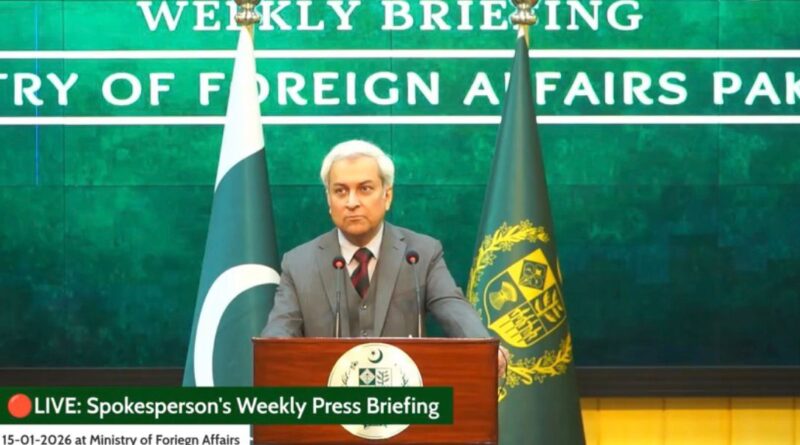
Islamabad: Pakistan on Thursday reiterated its commitment to regional peace, constructive diplomacy, and international law, as the Ministry of Foreign Affairs (MoFA) briefed the media on key foreign policy developments of the past week and responded to a wide range of questions on regional and global issues.
At the outset, the Foreign Office spokesperson outlined major diplomatic engagements, including Prime Minister Muhammad Shehbaz Sharif’s recent telephone conversation with the Amir of Qatar, Sheikh Tamim bin Hamad Al Thani. Both leaders expressed satisfaction over the positive trajectory of Pakistan–Qatar relations and discussed recent developments in the Middle East. The Prime Minister appreciated Qatar’s role in promoting peace and mediation in the region and reaffirmed Pakistan’s support for regional stability.
The spokesperson also highlighted President Asif Ali Zardari’s ongoing official visit to the Kingdom of Bahrain from January 13 to 16. During the visit, President Zardari met King Hamad bin Isa Al Khalifa in Manama, where discussions focused on trade, investment, defense cooperation, support for the Pakistani community, and regional and global issues. The Bahraini monarch conferred the Sheikh Isa Award on the President. The visit aims to further strengthen Pakistan’s longstanding ties with Bahrain and expand cooperation in economic, security, and people-to-people domains.
Deputy Prime Minister and Foreign Minister Senator Mohammad Ishaq Dar represented Pakistan at the 22nd Extraordinary Session of the OIC Council of Foreign Ministers held in Jeddah. Addressing the session, he strongly condemned Israel’s illegal recognition of the Somaliland region of Somalia, terming it a direct assault on Somalia’s sovereignty and territorial integrity. He also reaffirmed Pakistan’s unwavering support for the Palestinian cause and for the right to self-determination of the people of Jammu and Kashmir.
On the sidelines of the OIC meeting, the Deputy Prime Minister held bilateral meetings with his counterparts from Azerbaijan, Bangladesh, Maldives, and Egypt, as well as with Saudi Arabia’s Deputy Foreign Minister and the OIC Secretary General. During the visit, he inaugurated the new building of Pakistan’s Consulate General in Jeddah, emphasizing the government’s commitment to improving consular services for overseas Pakistanis, particularly the nearly 1.8 million Pakistanis residing in western Saudi Arabia.
The briefing further noted a series of high-level diplomatic contacts by the Deputy Prime Minister, including telephone conversations with the foreign ministers of Uzbekistan, Iran, Myanmar, and Indonesia, focusing on strengthening bilateral ties, regional developments, and economic cooperation.
Responding to questions, the spokesperson said Pakistan was closely monitoring developments in Iran and reiterated its desire for peace, stability, and prosperity in the neighboring country. Pakistan expressed confidence in the resilience of the Iranian people and leadership and hoped that economic relief measures would ease hardships faced by Iranian citizens. The spokesperson also advised Pakistani nationals to follow the existing travel advisory regarding Iran.
On reports of the United States suspending the processing of immigrant visas for several countries, including Pakistan, the Foreign Office said it was in contact with U.S. authorities to seek further details, describing the move as part of an internal review process.
Pakistan strongly condemned the conviction of Kashmiri leader Asiya Andrabi and her associates by an Indian court, calling the trials fabricated and a misuse of draconian laws to suppress legitimate political voices in Indian Illegally Occupied Jammu and Kashmir.
Addressing remarks by the Indian Army Chief, the spokesperson rejected allegations of terror camps in Pakistan, describing them as baseless and politically motivated. He said Pakistan’s sacrifices in the fight against terrorism were internationally recognized and urged India to refrain from irresponsible rhetoric.
On Gaza, Pakistan welcomed efforts toward sustaining the ceasefire and expressed hope that the next phase of the peace plan would lead to humanitarian relief and a credible political process for the establishment of an independent Palestinian state. The spokesperson clarified that no decision had yet been taken regarding participation in any International Stabilization Force for Gaza.
Regarding Pakistani students stranded in Afghanistan and Iran, the Foreign Office said embassies were actively engaged in facilitating their return and that dozens of students had already arrived safely in Pakistan.
The spokesperson also reiterated Pakistan’s consistent position that it would not allow its territory or airspace to be used against any neighboring country, affirming that this policy remained unchanged.
On broader regional and global issues — including Afghanistan, U.S.–Iran relations, trade matters, Kashmir, CPEC, and defense cooperation with Saudi Arabia — the Foreign Office emphasized dialogue, respect for sovereignty, adherence to international law, and peaceful resolution of disputes.
Concluding the briefing, the spokesperson said Pakistan remained hopeful that 2026 would be a year of peace and stability and would continue to play a constructive role in promoting regional and global harmony.