Global Leaders at Davos 2026: Dialogue, Division, and a New Agenda for Economic and Geopolitical Challenges
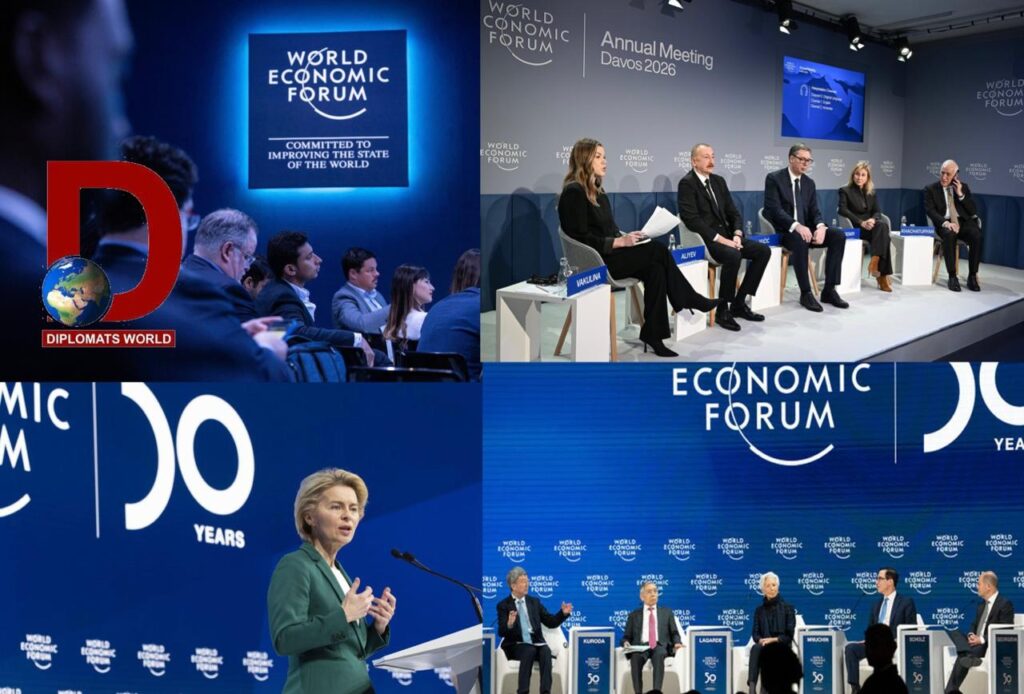
Islamabad : ( by Naeem Mehboob ) The 56th Annual Meeting of the World Economic Forum (WEF) is taking place in Davos‑Klosters, Switzerland from January 19–23, 2026. With nearly 3,000 participants including 400 political leaders from over 130 countries, around 850 CEOs, and close to 100 technology unicorn founders and innovators this year’s 2026 summit is one of the largest ever convened. The overarching theme is “A Spirit of Dialogue,” emphasizing cooperation amid deep geopolitical fractures and rapid technological change. 
Key Priorities and Proposals
- Renewing Global Cooperation in a Divided World
Leaders are grappling with strained international norms, rising great‑power rivalry, and waning trust in multilateral institutions. French President Emmanuel Macron warned of a “shift towards a world without rules,” highlighting the erosion of the international order.
Canadian Prime Minister Mark Carney echoed similar concerns, stating that the old world order is irreversibly changing and urging collective action over protectionist retreat. 
- Controversy Overshadowing the Economic Agenda
U.S. President Donald Trump’s attendance and his controversial proposal to acquire Greenland from Denmark has dominated headlines, creating diplomatic friction and risk of geopolitical escalation. European leaders have publicly opposed the move, straining U.S.–Europe relations.
Trump is also expected to unveil new domestic economic initiatives, including proposals on housing affordability and financial market interventions. 
- Tackling Inequality and Wealth Concentration
A significant and symbolic development at the forum has been an open letter signed by nearly 400 wealthy global citizens calling for higher taxation on the ultra‑rich. Signatories argue that entrenched wealth concentration undermines democracy, innovation, and sustainable development.
This appeal comes amid data showing record growth in billionaire wealth a key issue being pushed by civil society at Davos.
- AI and Technological Challenges
Executives and global tech leaders have voiced concerns about the responsible adoption of artificial intelligence (AI). Many companies report they are not capturing value from AI investments due to lack of foundational readiness, according to global business leaders at Davos.
In addition, organizations like OpenAI are highlighting the need to close the “capability overhang” gap the difference between AI systems’ potential and actual use to unlock broader economic and productivity benefits. 
- Climate Change and Energy Transitions
Although detailed global agreements have not yet been formalized, there is a growing consensus among participants that continued dependence on fossil fuels is no longer tenable for long‑term planetary and economic stability. Discussions are focusing on how to accelerate the just transition to renewable energy and secure sustainable investment pathways. - Pandemic Preparedness and Health Systems
Experts participating at Davos have raised alarms about the world’s lack of readiness for future pandemics, warning that climate change, geopolitical disruptions, and supply chain vulnerabilities increase the likelihood of larger outbreaks.
Notable Debates and Reforms
Globalization Under Scrutiny
Some leaders, including the U.S. Commerce Secretary, described traditional globalization models as having failed certain regions and worker populations, escalating debate over how to reform global trade practices in a way that benefits broader societal groups. 
Institutional Evolution of the WEF Itself
Amid criticism that Davos has become too exclusive or disconnected from global realities, the Forum is weighing relocating future annual meetings from Davos to other cities such as Detroit or Dublin — to broaden participation and reduce logistical constraints. 
Pakistan’s Role and Participation
Pakistan’s Prime Minister Shehbaz Sharif is attending the summit with a senior delegation, using the platform to showcase economic reforms, investment opportunities, and regional peace perspectives. He is also participating in business roundtables aimed at attracting global investment to Pakistan. 
Conclusion
The WEF Davos 2026 meeting remains a pivotal global forum where world leaders, business innovators, and civil society stakeholders converge to confront some of the most complex challenges of our time. While geopolitical tensions and controversial proposals have at times overshadowed the economic discussions, the summit continues to be a critical arena for dialogue on growth, cooperation, technology deployment, inequality, and sustainability.