China and Brazil Position Themselves as Defenders of UN Authority in Shifting Global Order
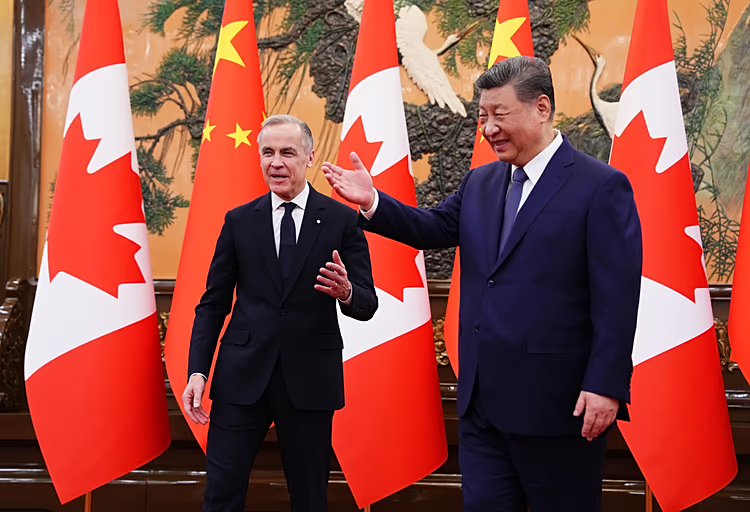
BEIJING : Chinese President Xi Jinping has urged countries to defend the “central role” of the United Nations in global affairs, calling on Brazil to work with China to uphold international norms amid growing unease over a proposed new global body championed by US President Donald Trump.
Xi made the remarks during a phone call on Friday with Brazilian President Luiz Inacio Lula da Silva, according to a readout published by China’s state broadcaster CCTV. He described the current global environment as “tumultuous” and said China and Brazil should act as “constructive forces” in preserving peace and stability.
“They should stand firmly on the right side of history and jointly uphold the central role of the United Nations, as well as international fairness and justice,” Xi was quoted as saying.
The comments follow Trump’s unveiling of his proposed “Board of Peace” at the World Economic Forum in Switzerland. While the initiative was initially presented as a mechanism to oversee Gaza’s reconstruction, its charter does not clearly limit its mandate to the Palestinian territory, prompting concerns in diplomatic circles that it could evolve into a parallel global body competing with the United Nations.
China and Brazil have both been invited to join the new grouping, but neither country has confirmed participation.
European leaders have also voiced skepticism about the proposal, with some viewing it as a potential attempt to sideline or even replace the UN. Speaking in Davos, Trump said the board, once established, “can do pretty much whatever we want,” while adding that it would operate “in conjunction with the United Nations.”
China’s Foreign Ministry reiterated earlier this week that “no matter how the international situation changes, China firmly upholds the international system with the United Nations at its core.”
Brazilian officials have echoed similar concerns. Brasília has warned that the Board of Peace could amount to “a revocation” of the UN’s authority. Lula’s special adviser, Celso Amorim, told Brazilian media that “we cannot consider a reform of the UN made by one country.”
China and Brazil have previously sought to present themselves as defenders of multilateralism, particularly during last year’s global tariff disputes, when both countries promoted the multilateral trading system as the foundation of global economic stability. Xi told Lula in August that the two nations could set an example of “self-reliance” for emerging powers.
Although China is a permanent member of the UN Security Council and remains deeply engaged with the international body, it has also objected to what it describes as external interference in domestic affairs. Rights groups, including Human Rights Watch, have accused Beijing of trying to weaken the UN system by cutting contributions to human rights budgets, promoting alternative mediation mechanisms, and restricting activist participation in UN forums.