
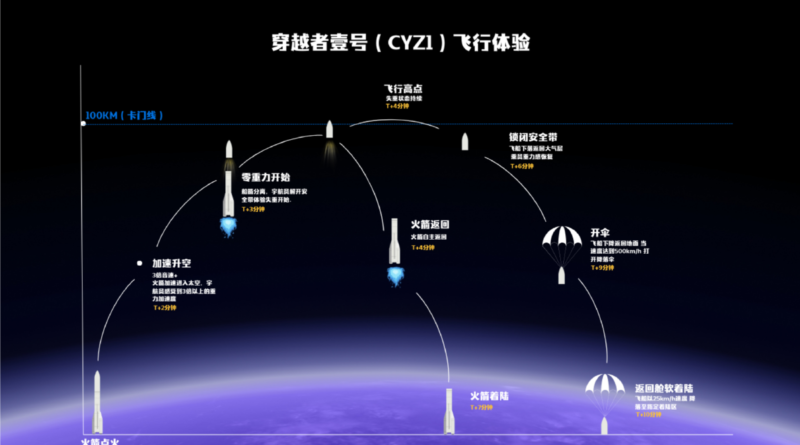
China Enters Commercial Space Tourism with CYZ1 Suborbital Flights
A Chinese private company has unveiled plans to launch suborbital space tourism by 2028, offering trips to the edge of space for 3 million yuan (approximately $430,000) per seat.
The company, InterstellOr, founded in early 2023, has already attracted about 20 passengers, including an actor, an engineer, a poet, and a businessman. Its CYZ1 spacecraft is designed to carry up to seven passengers to the Kármán line, the internationally recognized boundary of space at roughly 100 kilometers above Earth, for a weightless experience lasting between three and six minutes.
The announcement quickly became a trending topic on Chinese social media, with reactions ranging from excitement over China’s entry into commercial space tourism to concerns over the high cost, safety, and ambitious timeline. Digital influencer Miao Wang noted that while the ticket price may be prohibitive now, he hopes prices will drop to make space accessible to the general public.
According to Yang Yuguang, chairman of the Space Transportation Committee of the International Astronautical Federation, suborbital flights are technically less demanding than orbital missions, but rigorous safety verification and unmanned testing are essential before carrying paying passengers. Yang emphasized that the spacecraft needs to reach speeds of around 1 km/s, compared with 7.8 km/s for orbital travel, while maintaining strict safety standards.
InterstellOr has completed initial financing, a 2024 feasibility review, and conducted its first landing protection test this month. The venture follows the footsteps of the U.S. commercial space tourism industry, where Virgin Galactic and Blue Origin have been offering suborbital flights to paying customers, providing several minutes of microgravity experiences. Virgin Galactic tickets cost around $600,000, while Blue Origin’s initial seats have sold for as much as $28 million. Yang noted that with technological improvements and economies of scale, ticket prices could fall to one-tenth of current levels within a decade or two.
The announcement marks a significant milestone for China’s private aerospace sector and positions the country among the growing number of nations exploring commercial space tourism.