
NAB Reports Record Rs. 6.2 Trillion Recovery in Landmark 2025 Performance
Islamabad: ( by Naeem Mehboob ) The National Accountability Bureau (NAB) has released its Annual Performance Report for 2025, highlighting record financial recoveries, wide-ranging institutional reforms, and accelerated digital transformation, marking what the bureau described as a historic year in its operational history.
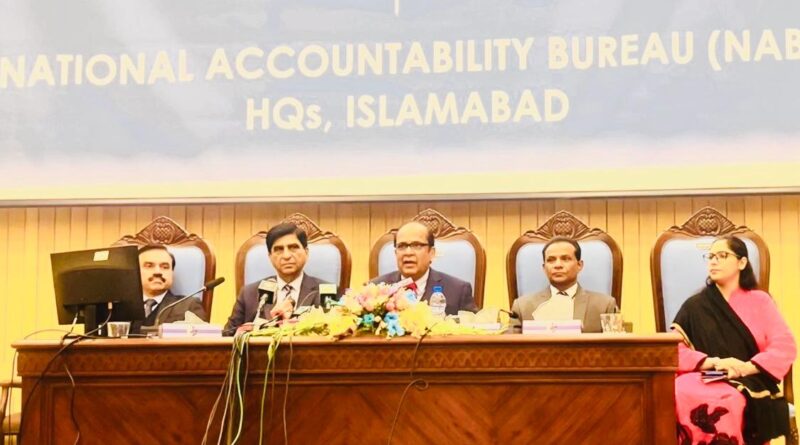
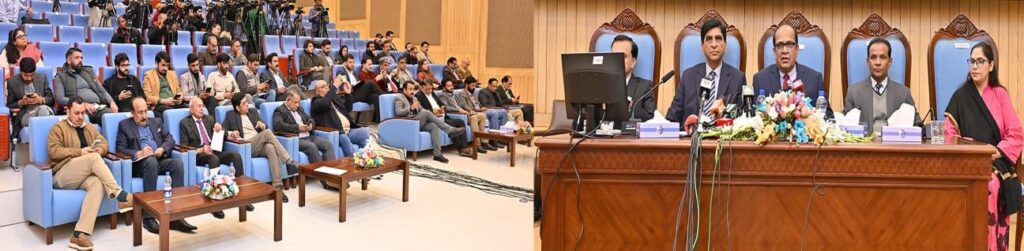
Senior NAB officials, including Deputy Chairman Sohail Nasir, Prosecutor General Ihtesham Qadir Shah, and Director General Amjad Majeed Aulakh, briefed journalists on the bureau’s achievements during the year.
Under the leadership of Chairman Lt Gen (Retd) Nazir Ahmed, NAB recorded an unprecedented recovery of Rs. 6.213 trillion in 2025 — the highest annual recovery since the bureau’s establishment in 1999. Over the past three years, NAB’s cumulative direct and indirect recoveries have reached Rs. 11.524 trillion, equivalent to approximately USD 41 billion, with 2025 alone accounting for more than half of the total. According to the report, recoveries achieved during the last three years are thirteen times higher than those recorded during the preceding 23 years.
A major contributor to this milestone was the recovery of 2.98 million acres of encroached state and forest land, valued at approximately Rs. 5.98 trillion. NAB Sukkur led regional efforts by reclaiming 1.63 million acres worth Rs. 3.73 trillion, followed by NAB Balochistan, which recovered 1.02 million acres valued at Rs. 1.374 trillion, and NAB Multan, which reclaimed 0.33 million acres worth Rs. 653.97 billion. In the Federal Capital Territory, 51 canals of precious state land, valued at Rs. 29.41 billion, were also recovered.
The report said NAB’s citizen-centric policies provided relief to 115,587 affectees of fraudulent housing and investment schemes through the disbursement of Rs. 180 billion. For the first time in NAB’s history, Rs. 2.8 billion was transferred directly into the bank accounts of 12,892 affectees through an agreement with the National Bank of Pakistan, eliminating the need for beneficiaries to visit NAB offices.
To preserve the time value of recovered funds, NAB introduced profit-bearing NIDA accounts, ensuring maximum financial benefit for claimants. During 2025, significant relief was provided in several high-profile cases, including Al-Bari Group (Rs. 5.4 billion to 1,126 affectees), Eden Housing (Rs. 4.362 billion to 11,889 affectees), State Life Cooperative Housing Society (plots worth Rs. 72.23 billion to 6,750 affectees), B4U Global (Rs. 3.157 billion to 17,500 affectees), and AAA Associates (Rs. 8.869 billion to 1,211 affectees). Additionally, Rs. 10.066 billion was recovered and disbursed to provincial governments and financial institutions.
Institutional revitalization efforts included the establishment of specialized facilitation cells for parliamentarians and government officials, the business community, and overseas Pakistanis. During the year, NAB handled 23,411 complaints, of which only 367 were found cognizable after verification. The report noted a 24 percent decline in new complaints compared to previous years, including a 52 percent reduction in complaints against public office holders and businessmen.
NAB completed 191 inquiries and 65 investigations, while 152 inquiries and 56 investigations were closed or referred to other departments. Under-process cases declined by 12.4 percent, while whistleblower-driven complaints increased by 41 percent.
The bureau expanded the use of AI-assisted investigation tools, blockchain analysis, and digital forensics, coordinated through the newly established Pakistan Anti-Corruption Academy (PACA). The academy conducted 42 training courses, focusing on white-collar crime investigations, anti-money laundering, terror financing, and digital intelligence. NAB’s prosecution success rate remained 72 percent, with approximately 302 references under trial in accountability courts during 2025. Following amendments to the NAO-1999, 246 references were transferred to other departments.
NAB also advanced its digital transformation agenda by transitioning to a paperless E-Office system and initiating the development of a Human Resource Management System (HRMS). In line with federal austerity measures, 238 posts were abolished, saving Rs. 356 million annually, while fuel reductions and virtual meetings significantly lowered operational costs. A dedicated inquiry cell disposed of 13 departmental inquiries, reinforcing internal accountability.
Internationally, NAB, as Pakistan’s Central Authority under the UNCAC, signed new memoranda of understanding with anti-corruption agencies in Malaysia, Saudi Arabia, and Nigeria. The bureau also attached Rs. 127 billion in assets across 39 high-profile anti-money laundering cases.
The report concluded that NAB’s 2025 performance reflects its transformation into a modern, transparent, and efficient accountability institution, combining record recoveries with digital innovation, institutional reform, and tangible public relief.
NAB #Accountability #AntiCorruption #PublicFunds #DigitalReforms #Governance #Pakistan #Transparency #RuleOfLaw #diplomatsWorld