Interpol Harnesses AI to Combat Global Cybercrime From Singapore
SINGAPORE : Artificial intelligence is transforming the battle against cybercrime at Interpol’s high-tech cybercrime facilities in Singapore, where experts combat crime syndicates structured like multinational corporations that exploit technology to target individuals, states, and corporations for billions of dollars.
Neal Jetton, Interpol’s Singapore-based Director of Cybercrime, described the weaponization of AI by cybercriminals as the organization’s “biggest threat,” noting that criminals are leveraging the technology in every possible way. Jetton, seconded from the US Secret Service, highlighted that even low-skilled offenders can purchase pre-made hacking tools on the dark web, putting anyone with a smartphone at risk.
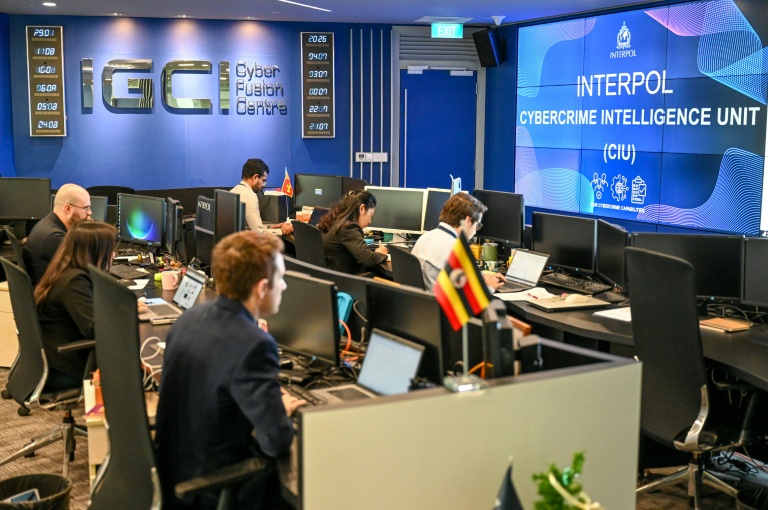
AFP was given access to the Interpol Global Complex for Innovation near the Singapore Botanic Gardens, which houses the Cyber Fusion Center. The center serves as a hub for sharing intelligence on online threats among 196 member countries, while a digital forensics lab analyzes data from devices including laptops, phones, and vehicles. A command-and-coordination center monitors global cyber developments in real time during Asian hours.
Christian Heggen, coordinator of the Cyber Intelligence Unit, described the challenge of a “large ecosystem of cyber criminals” operating a black market for stolen data, malware, and other digital tools. Interpol collaborates with private sector firms in finance, cybersecurity, and cryptocurrency analysis to strengthen its capabilities.
Interpol’s recent operations illustrate the scale of the threat. Last year, “Operation Secure” in Asia involved 26 countries dismantling over 20,000 malicious IP addresses and domains, while “Operation Serengeti 2.0” in Africa led to the arrest of 1,209 cybercriminals, recovery of more than $97 million, and the dismantling of 11,432 malicious infrastructures. These efforts were coordinated from Singapore with intelligence-sharing support.
Toshinobu Yasuhira, head of the Innovation Center, emphasized concerns over AI’s autonomy, noting challenges in determining accountability for AI-generated crimes. Experts including Paulo Noronha from Brazil’s Federal Police are exploring the use of virtual reality, augmented reality, and quantum technology to anticipate criminal moves and maintain an investigative edge.
For Jetton and colleagues, the work remains largely confidential, yet is critical for global security, providing vital support for operations and investigations worldwide.
Tags: Interpol, cybercrime, artificial intelligence, deepfakes, Cyber Fusion Center, digital forensics, global security, Singapore
#Interpol #Cybercrime #ArtificialIntelligence #Deepfakes #CyberFusionCenter #DigitalForensics #GlobalSecurity #Singapore #diplomatsWorld #diplomatsworld