
Is an ‘Islamic NATO’ Feasible? Debate Resurfaces Over a Broader Arab-Muslim Military Alliance

By Naeem Mehboob Senior Journalist Pakistan
Amid growing regional tensions and concerns over a possible U.S. strike on Iran, discussions about the formation of a broad Arab-Islamic political and military alliance have resurfaced in policy circles. The idea often described as an “Islamic NATO” is once again drawing attention, though concrete steps toward its realization remain elusive.
The concept was formally articulated in September 2024 by Turkish President Recep Tayyip Erdoğan, who called on Muslim-majority countries to unite against what he described as Israel’s “expansionist ambitions.” His remarks sparked debate across the Muslim world about the feasibility of a coordinated political and security framework capable of addressing shared strategic challenges.
A year later, in September 2025, Pakistan’s Defence Minister Khawaja Asif floated a similar proposal, explicitly suggesting the creation of an “Islamic NATO” a NATO-style military alliance composed of Islamic countries. His comments were seen by some analysts as a reflection of Islamabad’s evolving strategic calculations amid shifting regional alignments.
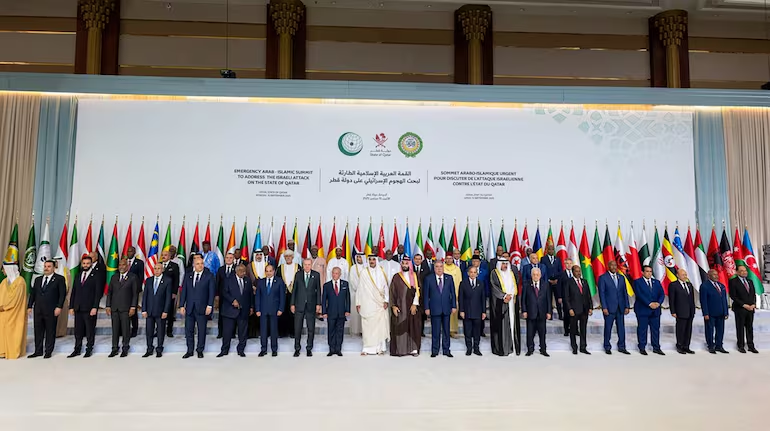
The idea appeared to gain further momentum on September 17, when Pakistan and Saudi Arabia signed a defense agreement, reinforcing military cooperation between the two longstanding partners. Although the agreement itself did not explicitly reference a broader alliance, it was interpreted by some observers as a potential building block toward deeper multilateral security coordination.
More recently, renewed speculation has emerged following President Erdoğan’s visits to Saudi Arabia and Egypt. Commentators have suggested that discussions about a wider coalition—potentially including major Muslim nations such as Turkey, Egypt, Saudi Arabia, Pakistan, and Indonesia—may be under consideration. However, no official confirmation or substantive evidence has yet been presented to indicate that a formal framework is being negotiated.
At the same time, some reports have cited a Saudi official as denying that any plan is currently under review to establish a Saudi-led “Islamic NATO” incorporating Turkey and Pakistan. The reported denial underscores the gap between public discourse and official policy positions.
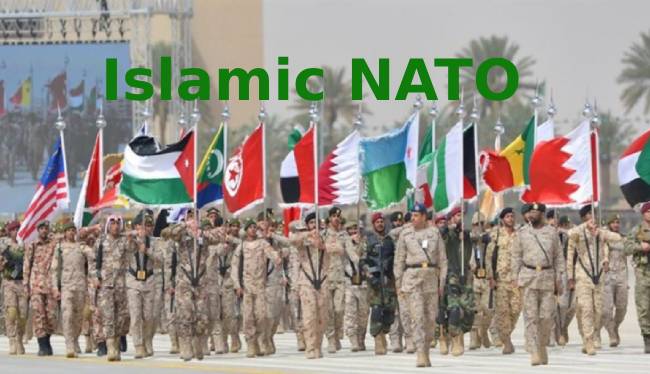
Strategic Appeal vs. Political Realities
Analysts note that the appeal of such an alliance lies in the perceived need for collective security amid mounting geopolitical uncertainty, particularly in light of U.S.-Iran tensions and broader regional rivalries. Proponents argue that a coordinated political and military bloc could enhance deterrence, strengthen diplomatic leverage, and foster defense interoperability among key Muslim-majority states.
Yet significant challenges remain. Divergent foreign policy priorities, intra-regional rivalries, differing threat perceptions, and varying relationships with global powers including the United States, China, and Russia complicate the prospects for a unified military structure. Moreover, the absence of a shared command architecture or binding security doctrine raises questions about operational feasibility.
As debates continue, the question remains whether the idea of an “Islamic NATO” is a realistic strategic project or primarily a political narrative shaped by evolving regional dynamics. For now, while discussions are intensifying, tangible evidence of a formal, institutionalized alliance remains limited.
In a region marked by fluid alliances and complex power balances, the prospect of a comprehensive Arab-Muslim military bloc may continue to surface in strategic discourse but translating rhetoric into reality would require overcoming formidable political and structural hurdles.