Azerbaijan, United States Sign Strategic Partnership Charter Covering Connectivity, Economy and Security
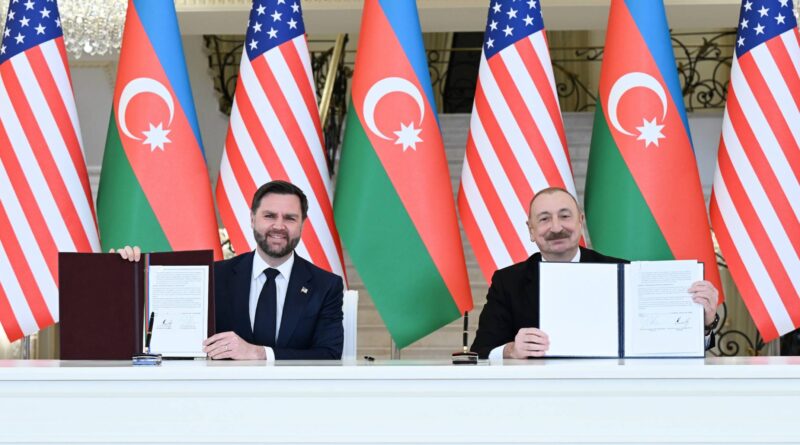
The Government of the Republic of Azerbaijan and the Government of the United States of America on February 10, 2026, formalized their bilateral ties by adopting a Charter on Strategic Partnership, reaffirming mutual support for sovereignty, independence, territorial integrity, and the inviolability of borders as the foundation of their relationship.
The Charter builds on a Memorandum of Understanding signed in Washington, D.C. on August 8, 2025, which established a working group to develop the framework for a strategic partnership between the two countries. Both sides affirmed the importance of deepening cooperation across areas of shared interest and benefit, including regional connectivity, economic investment, and security cooperation, with the active participation of both government institutions and the private sector.
Under the Charter’s first section on regional connectivity, including energy, trade, and transit, Azerbaijan and the United States expressed their intention to work together to promote regional connectivity, with particular focus on the Trans-Caspian Transport Corridor, also known as the Middle Corridor. Cooperation will cover land, maritime, and air transport infrastructure, energy and data connectivity, trade and transit facilitation, customs and border procedures, and international multimodal logistics.
The two governments acknowledged the importance of the Trump Route for International Peace and Prosperity (TRIPP) as a multimodal connectivity initiative aimed at ensuring unimpeded links between mainland Azerbaijan and the Nakhchivan Autonomous Republic. They noted that the project would generate reciprocal benefits for international and intra-state connectivity, unlock regional trade and transit potential, and align with the Washington Peace Summit Declaration of August 8, 2025.
The Charter also outlines plans to improve the business climate and expand trade and investment flows, building on the history of bilateral cooperation that produced major initiatives such as the Contract of the Century and the Southern Gas Corridor. Both sides intend to expand cooperation across energy, transport, and digital infrastructure sectors, mobilize public and private investment, and deepen collaboration on oil, gas, and electricity projects, including interconnectors and diversified supply routes.
Recognizing Azerbaijan’s role as a reliable partner in energy security, the two countries expressed their intention to expand bilateral and third-country energy cooperation, deepen civil nuclear collaboration, and facilitate the transit of critical minerals through the Middle Corridor to global markets.
The second section of the Charter focuses on economic investment, artificial intelligence, and digital infrastructure. The United States welcomed Azerbaijan’s efforts to integrate further into the global economy and strengthen its position as an energy, trade, data, finance, transport, and logistics hub for the Caspian region. Both sides intend to identify opportunities to increase bilateral trade and investment, including through potential economic and trade dialogue platforms, with strong private-sector participation.
The Charter emphasizes cooperation on artificial intelligence partnerships, digital infrastructure development, and, where appropriate, space industry collaboration. It also outlines plans to explore the creation of joint research and development mechanisms, innovation platforms, and sector-specific initiatives in cybersecurity and AI to support early-stage technology development, attract private capital, and accelerate commercialization.
In addition, Azerbaijan and the United States intend to share best practices and provide technical assistance in emerging technologies, foster talent development and a skilled technology workforce, promote cross-border and Trans-Caspian digital connectivity, and support joint research, development, commercialization, and voluntary technology transfer in line with applicable legal and regulatory frameworks.
Security cooperation forms the third pillar of the Charter. Both governments stated that peace in the South Caucasus serves their shared interests and that bilateral security cooperation contributes to regional and international stability. The United States acknowledged Azerbaijan’s contributions to international peacekeeping missions alongside US and coalition forces.
The two sides agreed to expand defense and security cooperation, including defense sales, enhance counterterrorism collaboration, strengthen cybersecurity and critical infrastructure protection, and cooperate on humanitarian demining through capacity building, financial support, and technology transfer, in view of the challenges Azerbaijan faces from landmine contamination.
The Charter’s final section establishes an institutional framework for implementation. As part of the existing strategic partnership structure, Azerbaijan and the United States may create working groups covering areas such as economy and trade, energy, connectivity, artificial intelligence and digital development, and security and defense. Within three months of the Charter’s signing, these working groups are expected to determine project lists and implementation roadmaps.
Both governments also committed to meeting at least once a year within the framework of the Charter and to establishing additional dialogue mechanisms as mutually agreed to ensure effective implementation of the partnership.
#Azerbaijan #UnitedStates #StrategicPartnership #Connectivity #Energy #ArtificialIntelligence #SecurityCooperation #MiddleCorridor #diplomatsWorld