Canadian PM Says Russia Poses Arctic Threat, Welcomes US-Led Gaza Peace Initiative
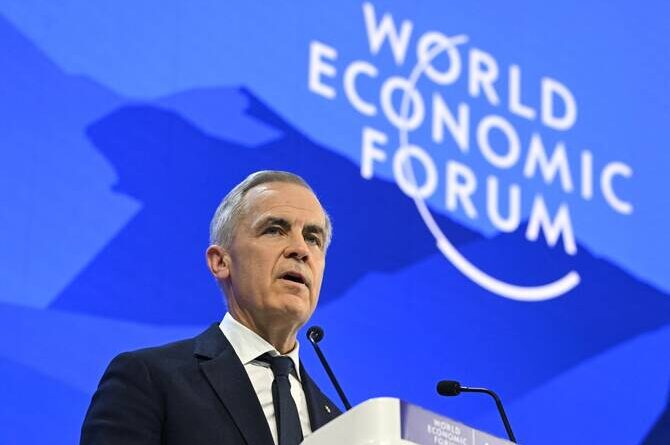
DAVOS — Canadian Prime Minister Mark Carney warned at the World Economic Forum on Tuesday that Russia poses a growing security threat in the Arctic, while voicing strong support for Denmark and its autonomous territory of Greenland.
Speaking at the annual gathering, Carney said Canada stood firmly alongside Greenland and Denmark and fully supported Greenland’s right to determine its own future. He also reaffirmed Canada’s “unwavering” commitment to NATO’s Article 5 collective defence clause, under which an attack on one alliance member is treated as an attack on all.
Carney said Ottawa was investing in over-the-horizon radar systems to counter potential Arctic threats, citing Russian missiles, submarines, aircraft and ground forces. He added that Canada was working closely with NATO allies, including the Nordic-Baltic Eight countries, to strengthen Arctic sovereignty and security.
“NATO is experiencing a test right now, and the first response to that test has to be to ensure the security of the Arctic in a robust way for all possibilities,” Carney said. Responding to questions about risks posed by Russia and China to Greenland, he said Russia was “without question” a threat that needed to be guarded against.
Greenland’s strategic importance has drawn increased international attention due to its mineral wealth and its position along major shipping routes linking Asia, Europe and North America. U.S. President Donald Trump has repeatedly said he wants to acquire Greenland, calling it essential to U.S. national security.
Carney’s remarks came a week after he and Chinese President Xi Jinping announced an agreement to lower tariffs on traded goods, signalling improved ties between Canada and China. The Canadian leader has been seeking to diversify trade beyond the United States amid continued uncertainty caused by tariffs imposed by Trump over the past year and fresh threats this week of additional duties on some European allies following their opposition to his Greenland ambitions.
Carney said Canada “strongly opposes tariffs over Greenland,” adding that while Ottawa has withstood significant U.S. pressure, it continues to work with Washington on issues related to Europe and the Middle East. He also responded to Trump’s comment that NATO would be in the “ash heap of history” without U.S. leadership.
Turning to the Middle East, Carney welcomed the launch of the U.S.-led “Board of Peace,” which marks the next phase of the Gaza ceasefire plan. The initiative focuses on the demilitarization of Hamas, interim governance by a Palestinian committee, and the start of Gaza’s reconstruction.
He said the United States had invited Canada to join the board under the framework of United Nations Security Council Resolution 2803, noting that it would be immediately operational in Gaza before potentially expanding to other conflict-affected regions.
Describing conditions in Gaza as “horrific,” Carney said more needed to be done to ensure the flow of humanitarian aid and to establish a credible path toward a two-state solution to the Israeli-Palestinian conflict.
While confirming that Canada had been invited to take a permanent seat on the Board of Peace — which would require a $1 billion contribution — Carney stopped short of saying whether Ottawa would accept.
“We would write checks and deliver in kind to improve the welfare of the people of Palestine,” he said, adding that Canada wanted assurances the support would directly contribute to peace-building outcomes.