China Hosts Cambodia Thailand Talks as Beijing Steps Up Mediator Role in Border Conflict
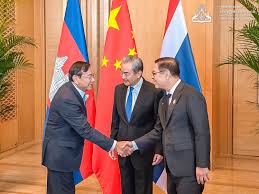
Foreign ministers from Cambodia and Thailand met with China’s top diplomat on Monday in a renewed push to stabilize a deadly border dispute, underscoring Beijing’s growing ambition to act as a regional and global mediator.
The trilateral talks were held in China’s southwestern Yunnan province, close to the contested frontier, just two days after Phnom Penh and Bangkok agreed to a new ceasefire aimed at ending weeks of fighting that left more than 100 people dead and displaced hundreds of thousands on both sides of the border.
“We haven’t resolved everything, but we are moving in the right direction and need to maintain momentum,” Thai Foreign Minister Sihasak Phuangketkeow told reporters after the meeting. He said the immediate priorities were ensuring the ceasefire holds and rebuilding trust between the two neighbors.
The choice of Yunnan—rather than Beijing—for the meeting was seen as symbolic, placing the talks closer to Southeast Asia and the conflict zone itself.
The gathering marked China’s latest effort to strengthen its profile as an international peacemaker, particularly in Asian regional crises. As its economic and political influence has expanded, Beijing has increasingly sought a role as a third-party broker in diplomatic disputes.
Chinese Foreign Minister Wang Yi urged all sides to work together to promote peace, stability and development in the region. “Allowing the flames of war to reignite is absolutely not what the people of the two countries want, and not what China, as your friend, wants to see,” Wang said.
Cambodian Foreign Minister Prak Sokhonn said he was confident the ceasefire would hold and create conditions for both countries to return to previously agreed mechanisms for resolving their differences. Sihasak also voiced hope for lasting peace with Cambodia.
China’s state news agency Xinhua later reported that the three countries agreed to uphold the ceasefire without backtracking, maintain dialogue and gradually restore bilateral relations. A joint statement released by Xinhua, Cambodia’s Agence Kampuchea Presse and Thailand’s Foreign Ministry said the talks included in-depth discussions on sustaining the truce and working toward the resumption of normal cross-border exchanges.
China also said it was prepared to provide immediate humanitarian assistance to displaced civilians and pledged cooperation with both countries to step up efforts against transnational crimes, including telecom and online scams.
Sihasak and Prak Sokhonn also held separate meetings with Wang on Sunday, the first day of the two-day engagement.
Despite the diplomatic push, tensions remain. An earlier ceasefire reached in July—brokered by Malaysia and reinforced by pressure from US President Donald Trump—failed to fully stop hostilities. While a more detailed agreement followed in October, sporadic violence and a bitter war of words persisted, erupting into heavy fighting again in early December.
Under the latest agreement, Thailand is to repatriate 18 Cambodian soldiers captured during July’s clashes once the ceasefire has held for 72 hours. Their return has been a key demand from Phnom Penh. The deal also calls on both sides to comply with international agreements banning land mines, a major concern for Thailand.
Sihasak said Bangkok would begin returning the Cambodian soldiers if the truce holds without incident for three days. He added that Thailand would also ask Cambodia to help facilitate the return of Thai nationals still in the Cambodian border city of Poipet.
Meanwhile, Cambodian Prime Minister Hun Manet appealed for restraint in a message to troops along the border. Even though we can still fight,” he said, “as a small country we have nothing to gain from prolonging the conflict. End / diplomats world