Global Growth, Cooperation, and China’s Strategic Role Highlighted at WEF 2026
China’s High-Level Opening-Up and Global Dialogue: Insights from Davos 2026
Special Analysis by Mr. Naeem Mehboob, Editor-in-Chief, DiplomatsWorld
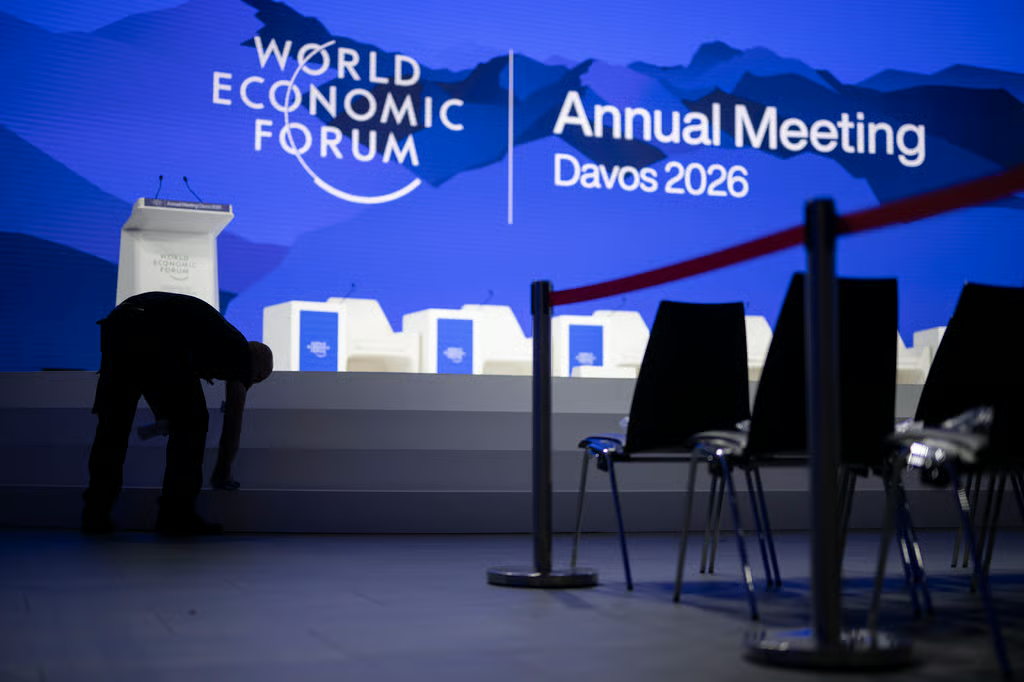
As the world’s political and economic elite gather in Davos-Klosters for the World Economic Forum (WEF) Annual Meeting 2026, under the resonant theme “A Spirit of Dialogue,” the forum assumes extraordinary significance. In an era defined by geopolitical uncertainty, fragmented supply chains, uneven economic recovery, and intensifying global competition, dialogue is no longer a diplomatic nicety; it is an indispensable mechanism for sustaining international cooperation and preventing systemic paralysis.
Amid this global backdrop, China’s engagement with Davos stands out for its consistency, vision, and strategic depth. Over the years, China has approached the forum not merely as a venue for economic exchange but as a stage to articulate its vision for global governance, continuity, and predictability—qualities increasingly rare in today’s volatile international system. Chinese Vice Premier He Lifeng, speaking at WEF 2026, emphasized that China’s development is an opportunity, not a threat, and reaffirmed Beijing’s willingness to leverage its market advantages to create shared opportunities for other countries.
China’s global economic footprint is undeniable. Contributing roughly 18 percent of global GDP, China’s role in driving worldwide growth often exceeds 30 percent, underlining a structural reality: China’s trajectory reverberates far beyond national borders. The timing of Davos 2026 is particularly critical, coinciding with the start of China’s 15th Five-Year Plan, where high-level opening-up is positioned as a central pillar of long-term development.
Unlike conventional market access policies, China’s high-level opening-up encompasses institutional transparency, alignment of rules, enhanced protection for foreign investment, integration into global value chains, and proactive participation in shaping international economic norms. In practice, this has involved a gradual shortening of negative lists for foreign investment, expansion of pilot free trade zones, and the promotion of high-standard trade agreements, including the Regional Comprehensive Economic Partnership (RCEP), now the world’s largest free trade area covering nearly 30 percent of global GDP.
China’s long-term strategy has produced measurable results. Despite global headwinds, the country remains a top destination for foreign direct investment, especially in high-tech manufacturing, green energy, and advanced services. In 2024 alone, foreign-invested enterprises accounted for nearly one-third of China’s total trade value, reflecting deep interdependence with the global economy.
The relevance of China’s opening-up is heightened amid the current era of intensified global competition, now extending beyond markets to standards, technologies, and development models. Yet, China’s Davos delegation conveys an alternative perspective: competition and cooperation are not mutually exclusive. When grounded in openness, predictability, and institutional engagement, competition can coexist with collaboration—offering a viable pathway for the Global South, whose access to markets, capital, technology, and infrastructure is critical for sustainable development.
China’s role in green technology is a tangible example of this cooperative potential. The country now produces over 70 percent of the world’s solar panels and supplies essential electric vehicle components, directly supporting global decarbonization. Likewise, China has consistently advocated for resilient, inclusive supply chains, positioning itself against economic fragmentation—a stance welcomed by multinational corporations seeking efficiency alongside diversification.
The WEF 2026 theme, “A Spirit of Dialogue,” aligns seamlessly with China’s international strategy. Dialogue, in this context, is an active instrument of coordination, trust-building, and problem-solving, not passive diplomacy. By pairing high-level opening-up with multilateral engagement, China presents itself as a stabilizing force in a volatile global landscape, reinforcing the view that openness is resilience, not vulnerability.
As global leaders search for new engines of growth, China’s experience offers a vital lesson: long-term prosperity depends on cooperation-driven scale as much as competition-driven innovation. The country’s sustained commitment to deeper opening-up, clearly articulated at WEF 2026 and supported by concrete policy measures, ensures that its trajectory will remain a key determinant of global economic dynamics for years to come.
Major Approval: WEF 2026 participants, including heads of state, business leaders, and global policy experts, have widely endorsed China’s commitment to openness and dialogue, highlighting its stabilizing role in international affairs and the promotion of inclusive, rules-based global governance.
In Davos 2026, the world debates dialogue as a theme; for China, it has long been a strategy—one that continues to shape its engagement with the world and the future of global growth itself.