
Helix Nebula Reveals Cosmic Recycling as Star’s Death Seeds Future Worlds
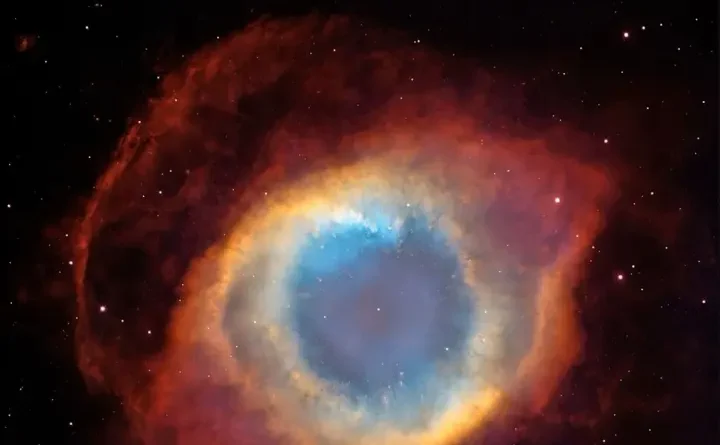
WASHINGTON : The James Webb Space Telescope has captured unprecedented images of the Helix Nebula, offering a striking view of the aftermath of a star’s death. Often called the “Eye of Sauron” or the “Eye of God” due to its distinctive appearance, the nebula lies 655 light-years from Earth and represents the final stages of a star once similar to our Sun.
The Webb telescope’s images reveal intricate details of the nebula’s structure and composition. At the center lies a white dwarf — the glowing remnant of a star — whose ultraviolet radiation illuminates the surrounding gas. The observations highlight distinct regions within the nebula:
- Blue glow: Hot ionized gas nearest the white dwarf.
- Golden and yellow filaments: Cooling molecular hydrogen regions.
- Red edges: The coldest dust clouds extending into space.
Scientists explain that these colors are more than just visual phenomena; they trace the transformation of a dying star into material that may eventually form new planets. Webb has also captured protective pockets in the dust clouds where complex molecules are beginning to emerge, signaling the early stages of new stellar formation.
Researchers say the imagery shows that the “last breath” of one star system may in fact sow the seeds for future planetary and stellar systems, providing a unique glimpse into the cosmic cycle of destruction and creation.