
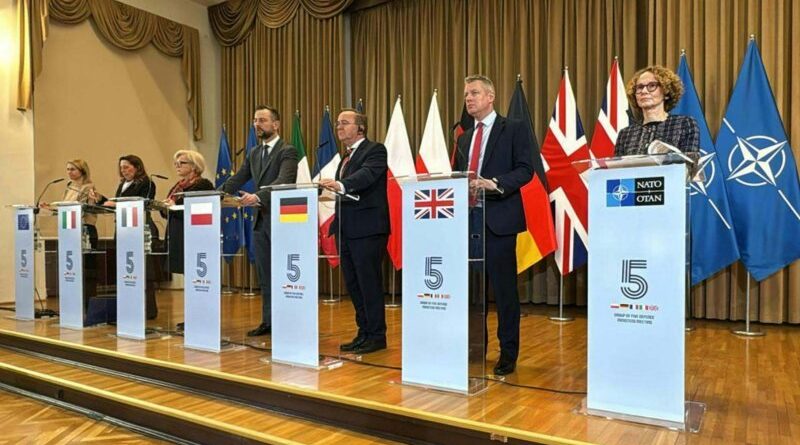
NATO Partners Plan Low-Cost Autonomous Drones
United Kingdom has announced a new defense agreement with four NATO allies to jointly manufacture low-cost drones aimed at strengthening Europe’s security architecture.
The initiative was unveiled by the European Group of Five (E5), comprising the United Kingdom, France, Germany, Italy, and Poland. The five nations confirmed they will launch the Low-Cost Effectors & Autonomous Platforms initiative, commonly referred to as LEAP.
According to a British government press release, the program is inspired by battlefield innovations demonstrated during the conflict in Ukraine. Officials noted that modern warfare has underscored the growing importance of affordable, scalable, and autonomous systems capable of responding quickly to emerging threats.
The primary objective of LEAP is to jointly develop low-cost autonomous drones that can be integrated into NATO’s defense framework. These systems are intended to help safeguard the airspace of allied nations against potential provocations, particularly from Russia.
Reports indicate that the initiative is designed to enhance collective defense capabilities by pooling technological expertise and manufacturing resources among participating countries. By standardizing development and production, the E5 nations aim to reduce costs and accelerate deployment timelines.
British officials stated that the first major focus of LEAP will be the development of a new lightweight and affordable surface-to-air weapon. The system is intended to counter drone swarms and missile threats, which have become increasingly prominent in modern conflicts.
Defense analysts note that the emphasis on cost-effective platforms reflects a strategic shift toward scalable deterrence. Rather than relying solely on high-cost, limited-quantity systems, European nations are exploring more flexible solutions capable of addressing sustained or asymmetric threats.
The announcement highlights growing defense cooperation among key European NATO members amid heightened regional tensions. Officials stressed that the initiative reinforces NATO’s broader commitment to collective security while adapting to evolving battlefield dynamics.
Further technical details regarding production timelines and funding structures are expected to be released in the coming months as the participating nations formalize implementation plans.