
Pakistan Criticizes Selective Nuclear Cooperation Arrangements
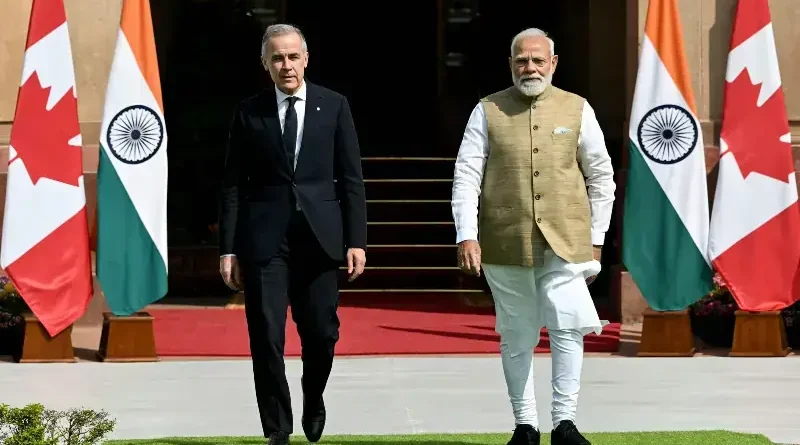
Pakistan has expressed concern over a long-term uranium supply agreement concluded between India and Canada, as well as their potential cooperation in the development of small modular reactors and advanced nuclear reactor technologies.

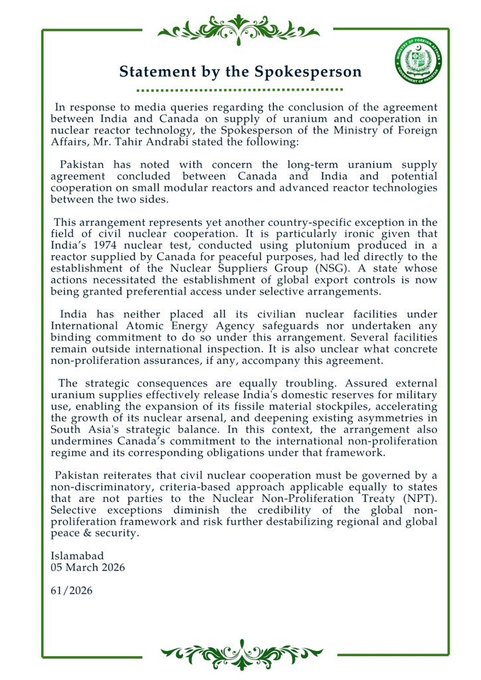
The statement was issued by the spokesperson of Pakistan’s Ministry of Foreign Affairs, Tahir Andrabi, in response to media queries regarding the agreement between the two countries.
Pakistan Warns of Strategic Impact of Uranium Deal
According to the spokesperson, Pakistan has taken note of the arrangement with concern, highlighting that it represents another country-specific exception in the field of civil nuclear cooperation.
The Foreign Office noted that the situation carries particular historical irony. India’s 1974 nuclear test was conducted using plutonium produced in a reactor that had been supplied by Canada for peaceful purposes. The test directly contributed to the establishment of the Nuclear Suppliers Group (NSG), which was formed to strengthen global export controls related to nuclear materials and technologies.
The statement said that a country whose actions led to the creation of international export control mechanisms is now being granted what Pakistan described as preferential access through selective arrangements.
Islamabad Questions Nuclear Cooperation Between India and Canada
Pakistan also pointed out that India has not placed all of its civilian nuclear facilities under the safeguards of the International Atomic Energy Agency (IAEA). According to the Foreign Office, several of India’s nuclear facilities remain outside international inspection mechanisms.
The spokesperson stated that under the new agreement it remains unclear what specific non-proliferation assurances, if any, have been incorporated into the arrangement.

The statement further highlighted concerns regarding the potential strategic implications of the agreement. According to the Foreign Office, guaranteed external uranium supplies could allow India to redirect its domestic uranium resources toward military purposes.
Pakistan Raises Concern Over India–Canada Uranium Agreement
Such a development, the spokesperson noted, could facilitate the expansion of India’s fissile material stockpiles and accelerate the growth of its nuclear arsenal. Pakistan said this could further deepen existing asymmetries in the strategic balance in South Asia.
Read Also; Israel Economy Could Lose 4.3 Billion Shekels Weekly
The Foreign Office also argued that the arrangement raises questions about Canada’s commitment to the international nuclear non-proliferation regime and the obligations associated with that framework.
Pakistan reiterated that civil nuclear cooperation should follow a non-discriminatory and criteria-based approach that applies equally to all states that are not parties to the Nuclear Non-Proliferation Treaty (NPT).
The spokesperson emphasized that selective exceptions in nuclear cooperation agreements weaken the credibility of the global non-proliferation system.
According to the statement, such arrangements risk undermining international efforts aimed at maintaining nuclear restraint and stability.
Pakistan further warned that preferential arrangements could contribute to instability in both regional and global security environments.
The Foreign Office reiterated its position that nuclear cooperation frameworks must be based on transparent and universally applicable standards to ensure fairness and maintain the integrity of international non-proliferation mechanisms.
The statement concluded by stressing that a consistent and non-discriminatory approach is essential for sustaining global peace, security, and stability in the nuclear domain.