Pakistan Finalises Multi-Billion Dollar Defence Export Deal with Libya
Pakistan has secured one of its largest-ever conventional arms export agreements, valued at several billion dollars, with Libya, according to four Pakistani officials cited by Reuters.
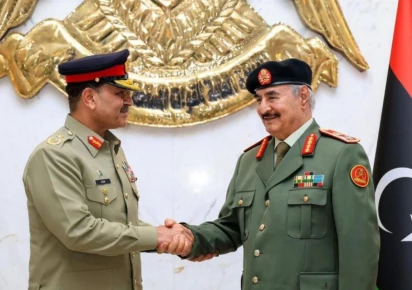
The agreement was concluded following a meeting last week in Benghazi between Pakistan’s Chief of Army Staff and Chief of Defence Forces, Field Marshal Syed Asim Munir, and Lieutenant General Saddam Khalifa Haftar, the Deputy Commander-in-Chief of the Libyan Armed Forces.
Officials involved in defence affairs said the deal remains sensitive and requested anonymity. Pakistan’s Foreign Office, Ministry of Defence, and military authorities did not issue any official comment in response to media inquiries.
Documents reviewed by Reuters ahead of the deal’s finalisation indicate that Libya will procure 16 JF-17 Thunder fighter aircraft—jointly produced by Pakistan and China—along with 12 Super Mushak trainer aircraft used for basic flight instruction. One Pakistani official confirmed the accuracy of the list, while another stated that all items mentioned were included, though exact quantities could not be independently verified.
According to the officials, the agreement spans military equipment for land, naval, and air forces and is expected to be executed over a period of approximately two and a half years.
Libyan National Army (LNA) media outlets also reported that a defence cooperation agreement had been signed with Pakistan, encompassing arms purchases, joint military training, and defence manufacturing collaboration, though specific details were not disclosed.
Sources described the deal as a significant breakthrough for Pakistan’s defence industry, placing the country among a limited group of nations capable of concluding large-scale conventional weapons exports.
The agreement, however, is likely to face international scrutiny due to Libya’s ongoing political instability following the 2011 NATO-backed uprising that led to the overthrow of Muammar Gaddafi and triggered prolonged conflict between rival administrations in the east and west of the country.
Libya has remained under a United Nations arms embargo since February 2011, imposed under UN Security Council Resolution 1970 and reinforced by subsequent resolutions, including Resolution 1973. The embargo formally bans the supply, sale, or transfer of weapons and related military equipment to Libya.
Despite these restrictions, weapons deliveries to Libya have continued over the years, contributing to proxy conflicts and further entrenching divisions among competing factions.