Pakistan, Kazakhstan Advance $7bn Rail Project to Link South and Central Asia
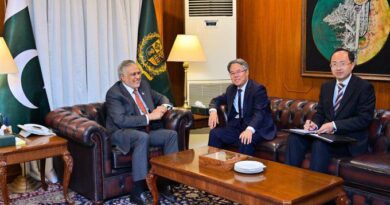
Islamabad : Pakistan and Kazakhstan on Thursday held high-level consultations at the Ministry of Railways aimed at strengthening regional connectivity and deepening bilateral cooperation in the railway sector, with a strong focus on rail corridors linking Pakistan to Central Asia.
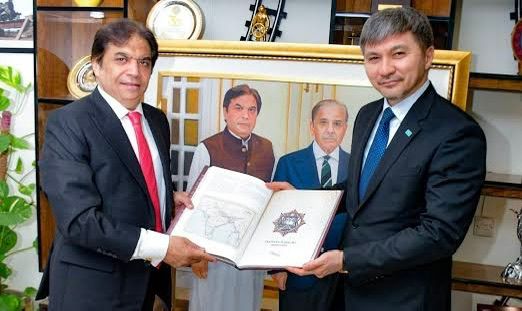
The meeting, attended by Federal Minister for Railways Muhammad Hanif Abbasi and Kazakhstan’s Ambassador Qystapa Erjan, reviewed ongoing initiatives designed to promote economic integration and expand trade through improved cross-border rail infrastructure.
Officials said the Pakistan–Kazakhstan rail link has been designated a strategic project under the Prime Minister’s Regional Connectivity Vision, positioning it as a cornerstone of broader regional integration efforts. Minister Abbasi described the initiative as a landmark development for Pakistan’s railway sector, calling it a historic step that would unlock new trade routes and strengthen regional linkages.
Participants were informed that substantial preparatory work has already been completed, including the development of a rail network connecting Karachi Port to Kazakhstan. The proposed route is designed to provide Pakistan with direct rail access to Central Asia, while extending through Chaman to link Afghanistan, Turkmenistan, and Kazakhstan, creating a comprehensive regional transport corridor.
The Pakistan–Kazakhstan Rail Connectivity Project, estimated at $7 billion, is expected to be completed within a record timeframe of three years. Once operational, officials said, the corridor is projected to transform regional trade flows and serve as a major catalyst for Pakistan’s economic growth.
The meeting also confirmed that the President of Kazakhstan is scheduled to visit Pakistan on February 3, 2026, during which a Memorandum of Understanding for the project will be formally signed, further strengthening bilateral cooperation in the railway sector.
Minister Abbasi подчеркed that beyond infrastructure modernization, the project is expected to play a pivotal role in boosting regional commerce, enhancing connectivity, and driving long-term economic development across South and Central Asia.