
Trump Imposes 10 Percent Global Tariff
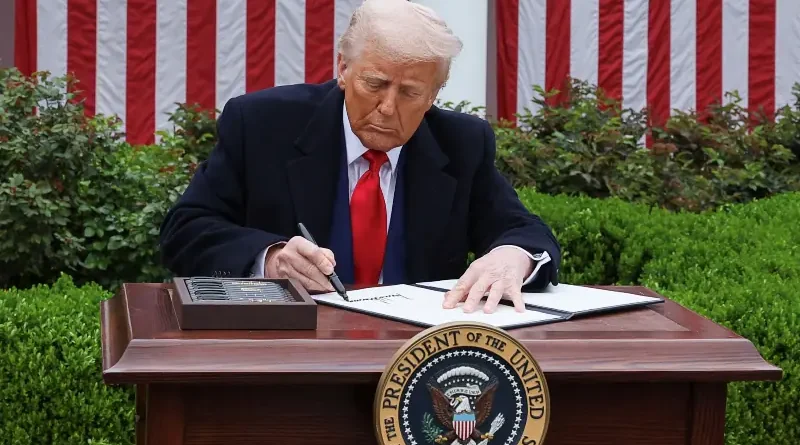
U.S. President Donald Trump has imposed an immediate 10 percent tariff on all countries, signing an executive order to formalize the decision. The move marks a significant shift in U.S. trade policy and introduces a broad-based import duty affecting goods entering the United States.
According to the White House, the 10 percent duty will apply to goods imported into the United States for a period of 150 days. Officials stated that certain categories of products will be temporarily exempt from the new tariff during this period.
The list of exempted items includes minerals, fertilizers, metals, and energy equipment. Agricultural products, medicines, and raw materials used in pharmaceutical manufacturing will also be excluded from the temporary import duty. Additionally, the new tariff will not apply to trade conducted under the United States-Mexico-Canada Agreement (USMCA), preserving existing commitments within that regional framework.
The announcement follows a prior ruling by the Supreme Court of the United States, which declared that additional tariffs previously imposed by President Trump on other countries were unlawful. In its decision, the court stated that the law cited by the administration to justify those tariffs was designed specifically for national emergencies. According to the ruling, the statute does not authorize the president to impose additional tariffs in the manner previously attempted.
Reacting to the court’s decision, President Trump expressed strong dissatisfaction. He said he felt embarrassed by certain members of the court, criticizing the ruling as misguided. Trump argued that while other countries might welcome the decision, their satisfaction would be short-lived. He maintained that tariff revenues would continue to increase despite the legal setback.
Describing the court’s ruling as disappointing, President Trump announced the new 10 percent tariff on all countries worldwide. The executive order formalizes that commitment and establishes the temporary duty structure outlined by the White House.
The administration has positioned the tariff as a measure intended to generate revenue and recalibrate trade relationships. However, the earlier Supreme Court ruling highlighted legal limits on the executive branch’s authority in matters involving trade policy, particularly when emergency powers are invoked.
While certain essential goods have been shielded from the temporary duty, the broad application of the 10 percent tariff signals a sweeping approach to import regulation. By exempting specific categories such as minerals, energy equipment, agricultural goods, and pharmaceuticals, the administration appears to be limiting potential disruptions in critical supply chains.
The decision not to apply the tariff to goods traded under the USMCA further indicates an effort to maintain stability in trade relations with Mexico and Canada. Nevertheless, the across-the-board tariff on other imports represents a substantial policy action with potential economic and diplomatic implications.
As the 150-day period begins, attention is expected to focus on how the tariff will affect trade flows, import costs, and international reactions. The executive order underscores President Trump’s continued reliance on tariff measures as a central component of his trade strategy, even in the face of judicial scrutiny.